
Catalog structure
We go through your range and create categories and subcategories, defining section names, specifications and navigation between pages.
We build a product catalog website for your company with categories, product cards, search and filters. Visitors find the right item, study its specifications and request a price or configuration. We plan the structure, design the pages and launch the catalog on your domain. We work with companies across Belarus.
From 1,800 BYN · from 20 business days
Before work starts we agree on the project scope, the amount of initial content and the timeline. The first month of technical support is included.
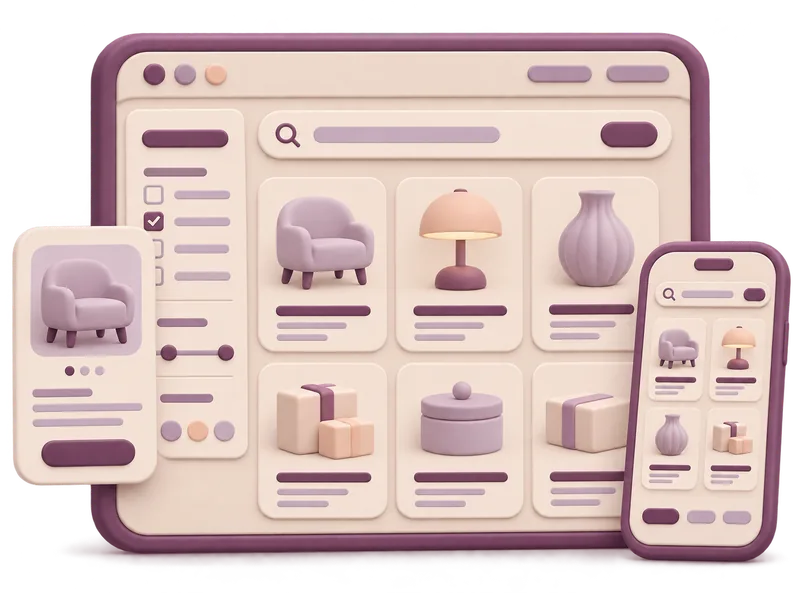
A catalog website suits companies that need to present their range and receive inquiries about specific products — when a deal requires confirming the price, configuration, volume or delivery terms.
We present product lines, specifications, versions and technical documents, so customers find the right model and request a quote.
We organize the range by category and brand and add item numbers and selection parameters. The request form is linked to the chosen product.
We show sizes, purpose, compatibility and configuration, with filters by the specifications your buyers actually use.
We provide price requests and model consultations. The price can be shown for the base version, as a range or on request.
See what categories, filters and product cards can look like. In the example you can open a model’s specifications, find a door by parameters and save the products you like.
 Entrance · Interior · HardwareDoors where home begins.
A considered choice for your interior.
From the first impression to every detail.
Answer three questions and we will show models for your needs.
Help me chooseThe door and hardware catalog has search by name and item number and filters by type, style, shade and price. Chosen items are collected into a list that can be downloaded to discuss the order. Your catalog’s design is created around your range and brand identity.
The core sections and features are agreed before work starts. The catalog gets one design system, and each product group gets the fields and parameters it needs.
We go through your range and create categories and subcategories, defining section names, specifications and navigation between pages.
We prepare a template with photos, a description, item number and specifications, and decide where to show the price, versions and documents.
We set up search and filtering by the agreed parameters: power and dimensions for equipment, composition, purpose and color for materials.
We design the catalog and inner pages and check filters, photo viewing, specification tables and forms on phones.
We add the agreed inquiry forms. The request includes the item’s name or number, so you can see what the customer is interested in.
We publish the website on the agreed hosting, connect the domain and HTTPS, check the pages and test inquiries, and hand over the files and access under the contract.
Timeline: from 20 business days
The starting price covers a catalog website with categories, product cards, search, filters and inquiry forms. We prepare an exact estimate after looking at your range and the features you need.
The number of product groups, catalog levels and product versions.
The set of specifications, product types, documents and selection rules.
The state of price lists, photos and descriptions, and how much content is needed at launch.
Data exchange with your accounting system, comparison, a personal account or other agreed tasks.
The estimate lists initial content entry, data import and extra features separately. The domain, hosting and paid third-party services are paid separately.
A category and a product page do different jobs. In a category visitors choose from the range; on a product page they study a specific item and contact you.
The fields depend on your products. We make room for the details customers check before ordering.
The inquiry names the selected product, so you can clarify the request and prepare an offer faster.
Before building the catalog we look at where your products are kept: a spreadsheet, an accounting system or an old website. We agree on the required fields, how updates work and the list of items for the initial upload.
We define categories, item numbers, specifications and photo guidelines, and prepare a spreadsheet template if needed.
We add the items manually or set up import from a prepared file. The volume and method are fixed before work starts.
If you will change products yourself, we include the editing interface you need in the project and show you how to use it.
We design the catalog for both buyers and the team that will run it, leaving room to grow after launch.
We build catalogs with modern technology and optimize images, code and data loading so categories, filters and product pages work fast on computers and phones.
We design specifications and filters around your products, so buyers narrow down the options by what matters to them and get to the right product.
Categories and products get their own URLs, headings and metadata. The structure can grow with search queries for product groups and specific models.
We provide reusable templates for product pages and sections, so new items fit into the catalog structure.
We agree on how cards, tables, documents and forms look and keep that system across sections, so visitors find their way around quickly.
The scope, price and timeline are fixed in a contract. For the first month we help with technical questions and small edits within the agreed scope.
A product catalog needs separate category and product pages. We lay down a structure that lets both buyers and search engines find the right sections.
SEO essentials are part of development. Extended keyword research, copywriting and further promotion are estimated separately. Search rankings depend on competition, content and further work on the website.
We agree on the sections, names, headings and internal links. Important products are reachable from the catalog.
We prepare URLs, titles and descriptions, canonical tags, robots.txt and sitemap.xml, and check that search engines can read the main content.
We decide which selections deserve their own pages and set technical rules for sorting, empty combinations and duplicate URLs.
We optimize images and page loading and check navigation, product specifications and forms on small screens.
Added to fit your company’s needs. The scope, price and third-party costs are agreed before development.
We discuss buyers, product groups, materials, inquiries and plans for the catalog.
We agree on categories, product card fields, filters and the path from choosing a product to an inquiry.
We show the home page, a category and a product page, and work out the same scenarios for phones.
We build the pages and features, load the agreed range and connect the forms.
We check filters, search, links and test inquiries, then publish the website and hand over the project.
The timeline of your project is fixed in the contract once the structure and materials are agreed. We show interim results at the planning, design and development stages.
On a catalog website buyers browse the range, choose items and send a request; the price, configuration and delivery terms can be confirmed with a manager. An online store adds a cart, checkout and the agreed payment and delivery options. The right format depends on how you sell.
The base scope includes the category structure, a product page template, design, a mobile version, search, the agreed filters, inquiry forms, SEO essentials and launch. Initial content entry and extra features are listed in the estimate. The domain and hosting are paid separately.
A base project takes from 20 business days. The timeline depends on the structure, filters, readiness of materials and the amount of content. The schedule is agreed before work starts. Preparing a large price list, extra features and long approvals are taken into account separately.
Yes. A product page can have a button to request a price or a configuration quote, and the request carries the selected product’s details. This works when the price depends on volume, version or delivery terms.
Yes, if the data is available in a suitable format. First we check the categories, item numbers, specifications and photos, then agree on the volume and method of transfer. Preparing the source file, import and regular updates are estimated for the actual task.
If your team will update the catalog, we provide an interface for the sections you need. We discuss which fields and materials should be editable, include this in the project and show you how it works after launch.
Yes. We prepare separate category and product pages, internal links, headings, metadata and technical indexing settings, with separate rules for filter pages. Further promotion requires work on the range, content and buyers’ queries; specific rankings cannot be guaranteed in advance.
Yes. If you plan an online store, extra languages or data exchange, we discuss it during planning. Each extension is estimated separately and agreed before development. The first month of technical support after launch is included; further support is available as a separate package.
Tell us what products you sell, how many items you plan to publish and which features buyers need. We will look at your materials, suggest a structure and prepare a quote for the catalog website.
A description of your range is enough for a first estimate. If you have a price list or a catalog example, mention it in your message and we will agree how to send the materials.